

$6.48 boost in GDP for each $1 invested in ARM Hub, report finds
Fri, 27th Nov 2026 (Today)
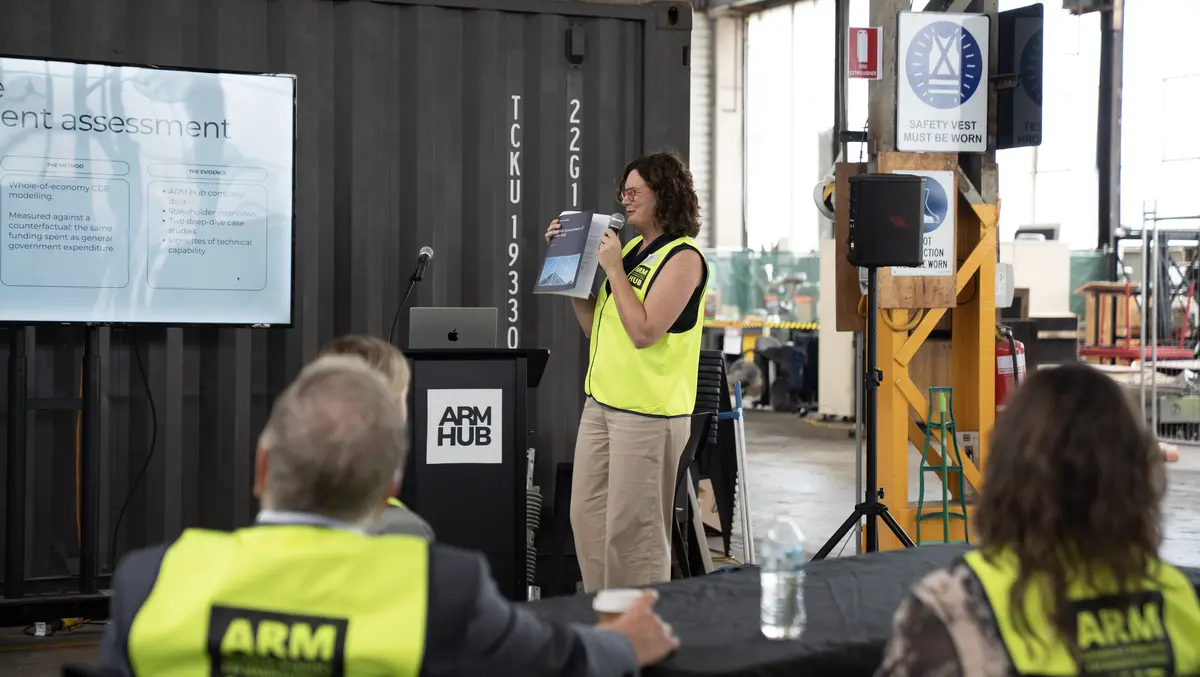
For every dollar invested, Brisbane-based AI, robotics and manufacturing not-for-profit ARM Hub could generate an additional $6.48 in GDP value, according to independent economic modelling.
The report, conducted by consultancy firm ACIL Allen, examined the economic and business impacts of ARM Hub's activities over a 10-year period, highlighting the potential returns from helping manufacturers adopt technologies including robotics, automation and artificial intelligence.
The findings suggest that investment in advanced manufacturing capabilities can deliver benefits beyond individual businesses, supporting workforce development, workplace safety, sovereign manufacturing, regional economies and Australia's broader industrial competitiveness.
Cori Stewart, CEO at ARM Hub, said the figure demonstrated the considerable economic value generated through the organisation's work.
"For every dollar invested, irrespective of whether it comes from local, state or federal investment, it generates an additional $6.48," Stewart said.
She said the modelling, which accounted for opportunity costs, provided an independently assessed measure of the economic contribution generated through ARM Hub's programs and strong industry partnerships.
The results are particularly significant because technology adoption often requires businesses to make substantial initial investments before seeing the full benefits.
Innovation typically follows an adoption curve, with companies initially facing higher costs before gradually realising productivity and operational improvements.
Workforce development and safety
The assessment also examined the employment and workforce implications of ARM Hub's activities, estimating that approximately 450,000 manufacturing workers would be impacted by its work over the 10-year period.
With Australia's labour market relatively tight, many workers in and around technology adoption are likely to transition from other industries or existing roles rather than enter entirely new positions.
The figure reflects the broader workforce development opportunities created through ARM Hub's programs, which help manufacturers develop the technical skills and capabilities needed to adopt new technologies.
Stewart said its approach was designed to ensure businesses developed their own internal expertise instead of becoming dependent on external technology providers.
The objective is to improve companies' ability to understand, implement and manage new systems, giving them greater capacity to continue innovating and making informed business decisions.
Workplace safety was another significant theme identified by ACIL Allen's research.
"If you can get your workers out of the way of something dangerous, you can get them off the really tedious jobs that sometimes have (that element of danger)," Stewart said.
"You can be more secure in your compliance and your regulation."
These improvements can deliver benefits for both employers and employees, with businesses achieving greater operational efficiency while improving working conditions.
Australia's established workplace safety and compliance requirements could also provide an advantage for manufacturers seeking to expand into international markets, Stewart noted.
"Having quite high safety standards and compliance requirements across industries (in Australia) means that we are quite good at creating automation that's going to be safe and secure," Stewart said.
"Therefore, companies can expand into new markets quite well. If they can certify in Australia, New Zealand, it usually means they can go into many other markets without a large additional regulatory burden."
Regional manufacturers facing multiple issues
ARM Hub's recent discussions with Queensland government representatives have increasingly focused on the importance of technology adoption for businesses operating in regional communities.
Manufacturers and other industrial businesses are facing mounting economic pressures, including rising operating costs and challenges competing in domestic and international markets.
"If our regional businesses are failing, if they're finding it too hard to operate, what we're doing is really diminishing communities, the ability for (regional) centres to work, towns to work, communities to work, and ultimately the state and the country to work," Stewart said.
Technology adoption can help businesses improve productivity, support existing employees and expand their operational capabilities without necessarily requiring substantial workforce growth.
Agriculture provides one example, with automated machinery allowing farmers to monitor equipment and complete other administrative or operational tasks while machinery performs work in the field.
Stewart said government representatives are increasingly recognising the practical benefits of technology when visiting businesses and seeing how automation could improve everyday operations.
Start-ups, established businesses on different automation paths
ARM Hub works with businesses at different stages of their technology adoption journeys, ranging from early-stage robotics start-ups to established manufacturers seeking to modernise existing operations.
One example is Burl Aerospace, an emerging Australian aerospace and robotics company developing an innovative drone propulsion system.
The local Queensland start-up has benefited from ARM Hub's facilities, which provide access to workspace, engineering expertise and industry connections without requiring the company to commit to an expensive, long-term lease.
Burl CEO Crighton Nichols has spoken about how the company was previously being run out of employees' garages with limited resources and funding.
ARM Hub allows early-stage businesses to bring engineers together, access technical support and pursue investment opportunities while limiting some of the financial risks associated with establishing manufacturing operations.
Another example is Urban Art Projects (UAP), an established Australian company specialising in large-scale public artworks.
The business began introducing robotics and automation into its operations years ago, recognising that traditional, largely manual manufacturing processes would eventually limit its ability to compete.
ARM Hub supported the company through a five-year research collaboration involving robotics, while also helping it explore augmented and virtual reality applications.
More recently, the focus has shifted towards unifying its business data to support artificial intelligence adoption and provide better operational insights.
Stewart said the combination of human craftsmanship and robotics had allowed UAP to develop new manufacturing capabilities and compete for major international public art commissions.
Young Guns Container Crew provides another example of technology being developed to address an existing operational challenge.
The Indigenous company, which operates in logistics and container handling, initially explored automation to reduce the physical demands and safety risks associated with manually loading and unloading shipping containers.
It subsequently began developing automated machinery capable of moving and palletising goods inside containers.
ARM Hub supported the company during its research and development process, including using virtual reality to simulate shipping container environments and assess potential workflows.
Young Guns has since progressed towards deploying the technology with major customers, such as retail giants Bunnings Warehouse and Kmart.