

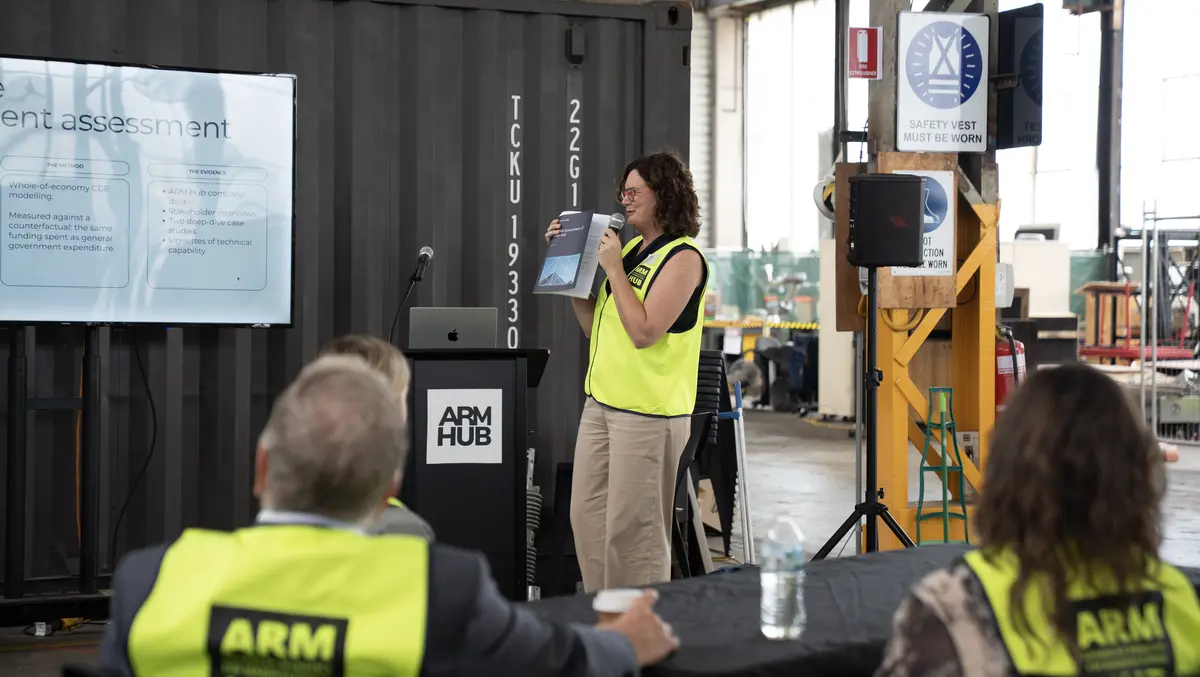
ARM Hub's Industry Day, held at their Northgate, Queensland base, brought together founders and CEOs, public servants, politicians and media to showcase the not-for-profit's mission as well as some of the most promising robotics and technology start-ups in the state.
It also marked the launch of a report by consulting firm ACIL Allen, projecting significant GDP gains from potential investment in ARM Hub.
The event was opened with an address by the Hon. Dale Last, Minister for Natural Resources and Mines, Minister for Manufacturing and Minister for Regional and Rural Development.
"The ACIL Allen assessment estimates that every dollar invested in ARM Hub by government and partners adds $6.48 to Australia's GDP," Last said.
"That is a modelled economic return, and a strong indication of what effective collaboration can deliver."
Impressive start-ups showcased
Burl Aerospace CEO Crighton Nichols was on hand to exhibit the aerospace engineering start-up's mission. With lofty goals of carrying hundreds of kilograms by drone, it is currently in the testing phase of adding incremental payloads with considerable transport and defence implications.
John Ferguson, Director at ProTx, detailed the technology that is already protecting roadside workers in Southeast Queensland today, and which the company hopes to deploy around the nation. The ProTx Arresta 100 is a specialised barrier designed to be towed by a standard work ute, rather than requiring cranes, specialist installation or a small army of trucks.
It utilises a sacrificial energy-absorbing cassette with crush boxes and rolled aluminium sections, allowing the main trailer body to be refitted with a new cassette after an impact.
"We started with an idea: could we use the impacting vehicle itself and catch and slow that?" Ferguson said.
"Five years of R&D and a lot of crash tests later, and then a full approvals process: this is the result."
Data from Austroads estimates there are close to 800 crashes at worksites throughout Australia annually, ranging from minor incidents to fatalities, with an estimated 18 deaths per year.
At seven metres long and weighing in at over two tonnes, Ferguson said the Arresta 100 was conceived to boost safety for roadside workers who are exposed to vehicles travelling at speed with only traffic cones, rudimentary barriers and at times confusing signage to protect them.
Rasmus Gupta, CEO at ProxGrid, spoke about the industrial applications for the start-up's technology. While it's unlikely something the average Australian gives much thought to, powerlines across the nation need to be cleaned just like other major infrastructure. Right now, that task is performed by humans, and is one of the most dangerous roles in the energy sector, as well as being very costly.
ProxGrid's technology utilises drones carrying a 13-kilogram payload to clean powerlines from the air, eliminating the need for a person to physically perform the same task under perilous conditions.
It also has wider use cases, capable of cleaning industrial tanks, towers, roofs and facades.
Start-up founders frustrated with funding, grant processes
A common theme from ARM Hub Industrial Day was the frustration from start-ups at local, state and federal funding programs.
Lack of industry knowledge, as well as the typical government bureaucracy and red tape, were cited as issues within the departments that are tasked with distributing funding and grants at various levels of government, said Nichols.
"There was the Australian Economic Accelerator (AEA) grants, that was federal government funding," he said.
"We applied for that. We were unsuccessful. (Government grants) are a lot of work for not a lot of money. There are always constraints on what you can and can't do.
"It's just a lot easier, I think, to get private funding. If I look at the pre-seed round, we got $260,000. If I was to get the equivalent grant, the amount of (work) I'd have to do to get that, it doesn't make sense."
That sentiment was shared by ProxGrid COO, Aiden Cairns. Encountering problems with grants that required matched funding from start-ups, ProxGrid eventually had more success with a WA-based accelerator.
"We're a deep-tech hardware company building drones that work on live powerlines, and most funding programs aren't designed for that," Cairns said.
"A lot of grants expect you to put in matched funding up front, which is a catch-22 for a pre-revenue start-up that's applying precisely because it doesn't have the cash. The applications themselves take a huge amount of time. You often wait months for an outcome while your runway keeps shrinking.
"The one bright spot for us was Western Australia's Founders Factory Nature Tech accelerator. The money was small, but it was quick and the program was practical. We're a Queensland company, and our first real support came from WA. It looks like a lot of Queensland grants have been paused or don't exist anymore."