

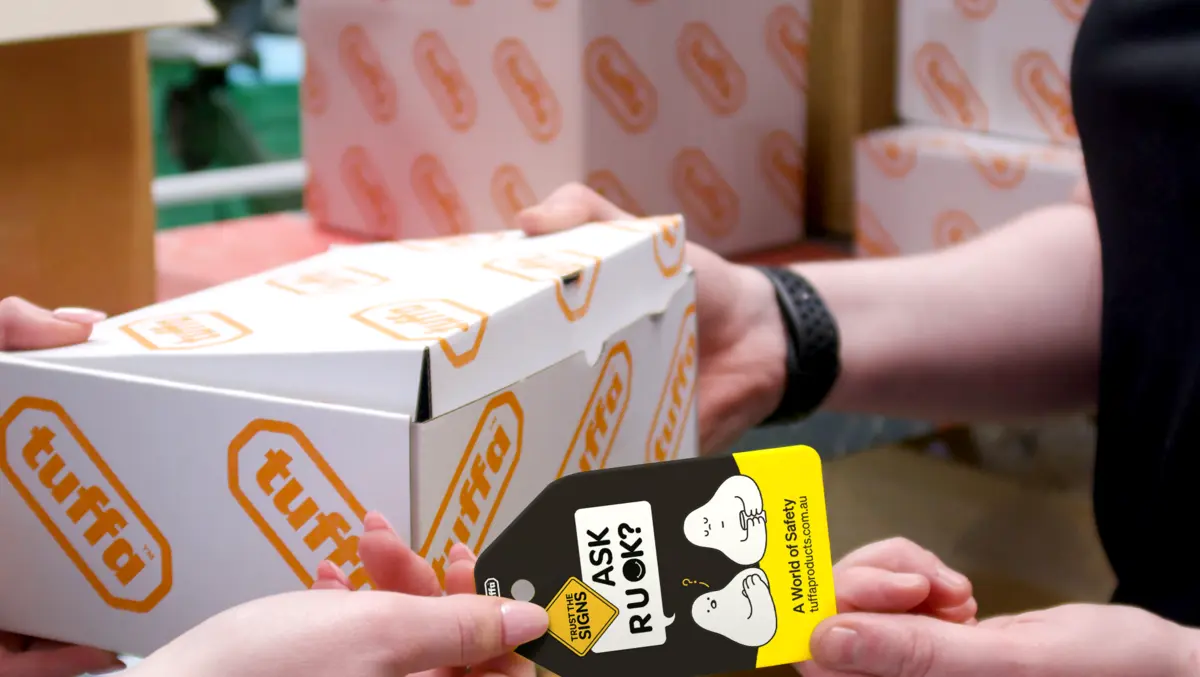
TUFFA tags prompt wellbeing talks in male workplaces
Wed, 9th Sep 2026
Australian safety manufacturer TUFFA is distributing 1,100 limited-edition R U OK? tags to workplaces across Australia, targeting trade, industrial and manufacturing settings.
The company is adapting its standard safety tags into prompts for conversations about wellbeing in workplaces where discussions about personal issues may be less common. Included with orders sent from TUFFA's warehouses in Condobolin and Canning Vale, the tags are intended to remain in workplaces after R U OK? Day as a reminder for workers to check in with colleagues.
Claire Standing, Marketing Manager at TUFFA, said the idea was to use a tool already familiar to industrial workers and tradies to encourage a different kind of safety discussion.
"In a workplace, we are trained to speak up when we see a physical hazard. We help one another complete the correct safety precautions and make sure a lockout procedure has been followed," said Claire Standing, Marketing Manager at TUFFA.
"However, for some people, particularly in traditionally male-dominated workplaces, saying 'I'm not OK' can feel much more difficult than saying 'I've got a problem with this machine'. So we wanted to make that first question easier to ask," Standing said.
The move reflects a wider debate about psychosocial health in sectors where safety systems have historically focused on physical risks, equipment and procedures. In these environments, employers and workers are used to spotting visible hazards, while signs of stress or mental strain can be harder to identify.
Workplace connection
The tags are designed for placement in toolboxes, lockers, workshop walls, crib rooms and lunchroom noticeboards. The aim is to put the prompt in everyday settings where workers already encounter safety messages and interact with one another during a shift.
Standing said psychosocial health should be treated as part of workplace safety rather than as a separate issue.
"Workplaces have an important role to play in psychosocial health because people spend such a significant part of their lives at work," Standing said.
"When people feel connected to those around them, know that someone will notice when they aren't themselves and feel comfortable having a conversation, that can make a real difference to how supported they feel," she said.
The emphasis on workplace connection is supported by findings from the 2026 Social Impact Report by Apprenticeships Are Us. Among 360 people surveyed, respondents reported average work satisfaction of 7.81 out of 11 and average life satisfaction of 7.72, while more than three-quarters recorded a wellbeing score of seven or higher.
The figures suggest a link between employment, social connection and wellbeing, particularly for people in vocational pathways and hands-on industries where team dynamics and peer support often shape day-to-day working life. They also indicate that work can be more than a source of income, serving as a place where routine, belonging and informal support networks develop.
Male workplaces
The campaign is aimed at sectors that remain heavily male-dominated, including trades, industrial operations and manufacturing. In many such workplaces, informal solidarity and practical support are well established, but conversations about emotional wellbeing may still be seen as difficult or unusual.
By using a familiar physical object rather than a separate poster campaign or formal training message, TUFFA is trying to place the question within the existing language of workplace safety. Workers already used to responding to tags, warnings and visual reminders may be more likely to engage with a prompt framed in the same way.
The approach also aligns with the culture of many work sites, where safety depends on workers noticing problems early and speaking up before risks escalate. In that sense, TUFFA is drawing a parallel between identifying a machine fault and recognising when a colleague may not be coping.
Standing said workers did not need specialist training to begin that conversation.
"You don't need to be a counsellor or have the perfect words. Sometimes the most important thing you can do is simply notice that someone isn't themselves and ask, 'Are you OK?'" she said.